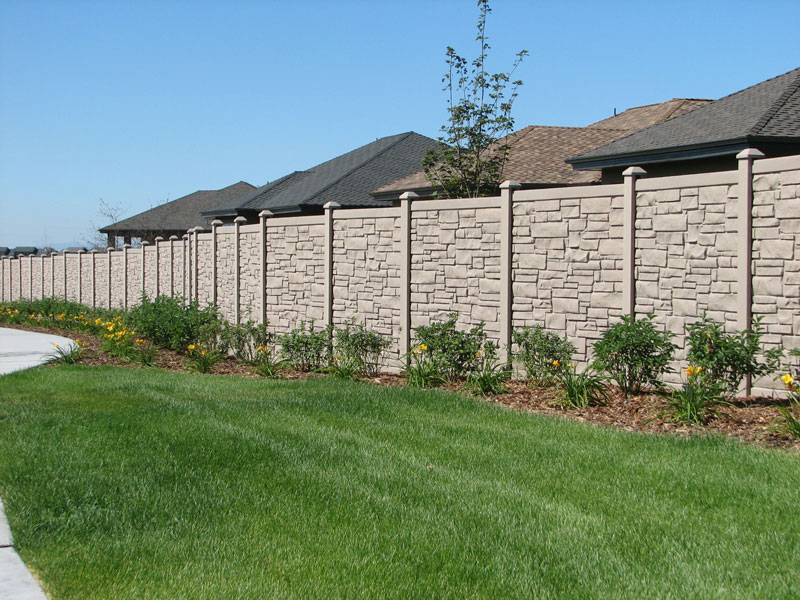
SimTek

The SimTek factory in Orem, Utah is only 15 miles north of Provo where Fence & Deck Supply calls home. With the close location to the factory, Fence & Deck Supply and SimTek have become great partners in the marketing and distribution of SimTek. Our national distribution division, FDS Distributors, ships product all over the US and Canada. Known as a “faux rock wall” and “simulated rock wall”, the fact remains the same that no matter what you call it, consumers are looking for the same thing; an alternative to the costs that come with building a true rock wall.

Fence & Deck Supply has seen SimTek used in all aspects of the fencing application. Installed at an attorney’s home in New York, a doggy day care in North Carolina, the Dearborn, Michigan Proving Grounds of Ford Motors and the iconic Salt Lake City Temple in Utah, SimTek’s applications have no limitations. Receiving calls from business like hotels, apartments, and condominiums, SimTek give the privacy and sound barrier that people expect with a rock wall. With seven colors and variable styles from height to semi-privacy, SimTek is the right product for you. 

SimTek EcoStone Beige Granite

SimTek EcoStone Beige Granite

Design Attributes

As mentioned, while a fence is primarily a functional element, aesthetics matter. In privacy fencing, this is particularly true because of the high visibility of the object. A consumer that is willing to invest in the landscaping of their property is likely to see a fence as an extension of their living space environment. Manufacturers of composites generally have taken one of two approaches with their products: 1) create a design that simulates a wood fence (examples are Timbertech FenceScapes and Fiberon Fencing), or 2) create a distinct design with a premium appearance. In the former, the advantage of a composite is that part of the material is composed of natural material, typically wood or another form of reclaimed organic waste. This gives the product a more wood-like appearance and texture, and is much less reflective than vinyl. In the latter, a well-designed composite fence takes advantage of the natural attributes of its wood-based elements but because it is a manufactured product, the dimensions and aesthetics of the fence can carry a look of exceptional quality and greater value.

The benefit of a simulated look is that if a proximity to a wood appearance is preferred, composites are the best low-maintenance alternative. Composites tend to hold a richer color value than vinyl, have excellent durability, and perform better in the elements over time. However, cost becomes an issue with this design. The traditional stockade (dog-ear) style fence is more expensive than a similar wood fence, so the low-maintenance benefit may not be enough to overcome the price difference. Adding fascia rails or a top “cap” rail to create a more attractive design increases the cost, further challenging the justification for a higher-cost composite.

System-oriented fencing, on the other hand, can differ considerably in appearance but can keep the costs closer to a stockade style composite fence. Trex in particular has been successful with this design. The picture frame, shadow box (board-on-board) design creates an identical look for both sides of the fence. This is significant, particularly in residential installations where neighbors often share the cost of a fence. The fencing also centers within the post profile making it easy to center the fence on property lines. Despite its durability and strength, no composite is load bearing so the propensity for sagging is quite high. Rather than using treated wood support rails, however, the Trex fence design uses a metal (galvanized steel or aluminum) bottom rail which supports the entire fence. Because the fence is also constructed in components, the number of fasteners required is fewer than traditional wood or other composite fences.

Another unique element of a composite product is that they typically made from at least some recycled content. As sustainable building gains ground in public interest and in building requirements, composites are increasingly included in plan specifications. Timbertech, Fiberon, Terra Fence, and Trex use 51%, 84%, 94% and 95% recycled content respectively. All have green manufacturing processes as well and qualify for U.S. Green Building Council LEED certification points. Partially due to”green” criteria, Trex was selected recently in a Utah for public transportation initiative to run approximately 17,000 along a light rail line. The U.S. Forestry service also selected the product for the Black Hills National Park in South Dakota for similar reasons.

Composite fencing as a next-generation product

Composite products have risen in recent years as a newer generation alternative to wood and fully-plastic materials. Composites combine natural and man-made elements for a stronger and aesthetically different product than traditional PVC-based materials. They have been substantially successful in decking, siding, and flooring applications gaining traction year-over-year. Companies like Fiberon, Nature’s Composites, Timbertech, and Trex that have been successful previously with composite decking or other products began introducing composite fencing profiles in the mid-2000’s.

Until recently, adoption of composites in fencing has lagged. Key limiting factors were poor product design and quality, high production costs, and difficulties in using traditional distribution channels. Introducing new products also mean significant investment in marketing to build product and brand awareness. In principle, the key attributes of composites dictate that they are the most likely alternative to vinyl fencing. Composites are stronger and more durable than other synthetic products. They use a dense, thick-wall profile that makes them resistant to the types of breakage common in vinyl or other PVC products. For example, in tests where Trex Seculsions posts and pickets were subjected to strikes from objects such as gravel, golf balls, and baseballs, the material did not break. In a Miami-Dade County wind test, Trex also performed well sustaining 110 mph constant and 130 mph burst speeds with no failure.

,

Step vs. Slope

There are very few yards that are perfectly level. So when deciding to install a fence, you have to decide what the best way is to deal with a change in the level of the yard. If there is only a slight change in the grade, you can hire someone to level the ground. Usually this doesn’t cost too much. If this isn’t an option, there are two other ways to deal with unlevel ground. Stepping or sloping.

Stepping a fence is where each panel is level, and the panels are stepped down along the grade of the ground. There are some types of fences that come in solid panels and can only be installed by stepping the fence. This method can leave gaps under a portion of the panels, but this can be remedied by putting some fill dirt or some sort of landscaping at the base of the fence.

Sloping is another method of building a fence along the grade of a yard. This means the panels are shifted to follow the slope of the ground, leaving little to no gap under the fence. It also gives a cleaner look between the fence and the ground.

If you are unsure which method would be the best, ask the estimator who gives the bid for your new fence installation. See more information at http://www.fenceutah.com/sloping-and-stepping/.

Steel vs. Aluminum Ornamental Fencing

Ornamental metal fencing has evolved over time due to the advances in technology and availability of raw materials. This type of fencing often called Wrought Iron is frequently mispronounced “rod iron fence.” Wrought Iron or “commercial iron” was prevalent in the days before mild steel came into production. Wrought meaning worked by hand described how this crude metal with a low carbon content and fibrous inclusions, known slag were manipulated by blacksmiths. While wrought iron is tough, malleable, ductile and easily welded, in reality it is no longer a material used for fencing.

In the 21st century the most common metals used for ornamental fencing are steel and aluminum.

Aluminum

While there are certainly a nice variety of fencing styles the major drawback for this material is strength. Uncoated Aluminum certainly performs better than steel in the category of red rust and resistance to salt spray for fencing in direct contact with the ocean.

Steel

The state of the art coatings on steel ornamental fencing offset the risk of rust and corrosion prevalent in the true wrought iron fencing. And the strength and durability of these panels and gates is far superior to aluminum.

Why Trex fence over wood or vinyl?

Why Trex fence over wood or vinyl?

Wood and vinyl fence products have dominated the fence market for a long time. Traditional wood fences have been used since the early 19th century and have been the most cost efficient fence on the market. Vinyl fences became very popular in the mid 90’s when a poly vinyl chloride product was innovated for a low-maintenance, semi-durable, inexpensive, and neighbor friendly design. The fence industry is now noticing another change in the fence market with the next generation of fencing towards wood composite fences. Wood composite fences cost more than wood or vinyl because of the virtues composite fencing has to offer. See the comparison chart below that can be found on http://www.trexfencing.com/comparison.

Take the strength and the look of a wood fence with the low-maintenance of a vinyl fence and what do you create? A wood composite fence. These two reasons are why composite fencing is the next generation in the fence market. Consumers are tired of the synthetic fence look that does not provide a wood appeal. Consumers are also tired of destroying our national forests to build wood products.

Some composite fence manufactures such as Fiberon, Timbertech, Moisture Shield, or Nature Composites have tried to mimic a traditional style wood fence by providing wood composite fence pickets. These composite fence pickets are relatively expensive and still do not provide the best solution for a fully composite fence because of the composite quality, warping, bending, and unnatural feel of a wood fence. Usually these composite fence products like the pickets are composite but usually the rail’s core and interior framed wall of the posts are wood with a composite wrap or the rail’s and posts are metal. For a comparison chart and additional product information on composite fences go tohttp://www.compositefencing.net/composite-fencing-comparison/. Keep in mind that composite fences are combined with wood and plastic for two purposes: plastic shields wood from moisture and insect damage and wood protects plastic ultra violet damage. With having all composite fence materials will not cause the fence to corrode, warp, rot, and splinter unlike the other composite fence products that could happen because of the pure wood and metal pieces within the fence products.

Trex Fencing provides a solution for a fully upscale composite fence without any wood not combined with plastic. The only two pieces on a Trex fence that are not wood composites are the aluminum bottom rail that provides weight support for a section of fence and the nylon glass fence brackets (refer to websitehttp://www.trexfencing.com/technical-resources for exploded view of the fence in color or see picture below). Also unlike other most composite fences on the market, Trex fencing has been engineered, proven, and tested. Trex fencing has thousands of lineal footage installed throughout the United States and Canada. Trex fencing is also considered a “Green” product because of the 96% recycled content that qualifies for LEED® Certification (http://www.trex.com/trex/groups/content/@mktg/documents/document/trexmd_001644.pdf).

Just like the great poet Robert Frost said, “Good fences makes good neighbors.” Truly this statement correct because having a “Good” fence along a shared property line provides privacy, low-maintenance for property line owners, and reduces trespassing.

For more details and how to order Trex fencing from CFC Distributors go to www.FenceSellers.com.

Fence & Deck Supply and FDS Distributors Leads the Way

Here is an article that I stumbled upon that reminds me how far trex has come. It’s hard to imagine that in such a short time Trex composite materials have become a preferred building material among contractors. Fence & Deck Supply in Utah has been a driving force in the success of Trex building products across the state. Today we service markets across the United States. As the largest supplier of Trex Seclusions fencing, FDS has adapted to the changing demands from contractors and homeowners.

Our national partner, FDS Fence Distributors, now offers Trex Fencing by the job. This allows for the homeowner or contractor to buy only what they need when they want it. Reducing the amount of overhead that a fence contractor needs to have allows them to be more flexible in their business operations. As a leading pioneer in the capabilities and demands of Trex Fencing , FDS Fence Distributors can provide you not only with the product but the expertise needed to successfully complete your project.

Fence & Deck Supply is centrally located in the state of Utah and is quickly expanding to meet the demand of our customers. Fence & Deck Supply is a Trex authorized supplier. We are proud to say that we don’t follow the competition, we lead the way. If you are in Utah, call our Fence & Deck Supply locations. If you are outside of Utah and are interested in Trex fencing products, feel free to contact us at 877-700-8739.

Trex Easy Care Decking Voted Number One By American Homestyle & Gardening Magazine Readers
WINCHESTER, VA–(BUSINESS WIRE)–December 1, 1999–What is the most popular home product of 1999? Trex(R) Easy Care Decking(R), according to American Homestyle & Gardening Magazine’s Reader’s Choice Awards. In the July/August 1999 issue, the magazine invited readers to vote for their favorite home products in a two-page color spread that featured 53 products nominated in a variety of categories. Trex decking was voted as the number one favorite with more than 4,000 votes. Trex decking and the runners-up are featured in the December/January 2000 issue of American Homestyle & Gardening.Manufactured by Trex Company of Winchester, VA, Trex decking answers the needs of busy homeowners seeking an attractive outdoor living space without the continuous care required by wood-surfaced decks. Trex decking never needs stains or sealants to keep its long-lasting good looks and will not rot, crack or split due to moisture, sunlight or insects. And, because Trex decking is completely splinter-free, families can go barefoot without a care! Homeowners will also be pleased to know that Trex decking is the only decking lumber of its kind to be code-listed by the nation’s three major building code agencies.

“We are very pleased and honored that the readers of American Homestyle & Gardening recognize the numerous benefits of Trex decking,” said Andy Ferrari, Executive Vice President, Sales & Marketing. From a style standpoint, Ferrari said the company encourages homeowners and their contractors to “think outside the rectangle” when planning to build a deck. “With Trex decking, the design possibilities are endless,” he said. “Trex finishes off beautifully with regular woodworking tools and curved shapes can be created easily. And, the homeowner is not limited to a rectangular deck. We’ve seen some incredible Trex decks that are completely round, octagonal or that incorporate curves and angles not possible with other decking lumber.”

Trex decking is made primarily from recycled plastic grocery bags, reclaimed pallet wrap and waste wood. The company reminds consumers to bring their plastic grocery sacks back to the supermarket recycling bin, because they are truly making an impact. In fact, Trex Company used more than 90 million pounds of reclaimed plastic last year along with equal amounts of waste wood fiber to manufacture Trex decking. Due to the product’s growing popularity, Trex Company unveiled a brand new, state-of-the-art production facility in Fernley, Nevada this past summer to complement its original plant in Winchester, Virginia.

Trex decking has a proven track record in the harshest environments in North America. It has been used for miles of boardwalk along the seashores in New Jersey, Massachusetts and Rhode Island and along Lake Ontario in Toronto, Canada; for the Presidential Trail at Mt. Rushmore and for walkways throughout the Florida Everglades.

Neighbor Friendly Fences

There are many types of fences to choose from when considering a fence to put onto your property. One type is a “neighbor-friendly” fence, where it looks the same on both sides of the fence. Fortress Iron and Trex composite fencing automatically look the same on both sides. The type of fence that is usually a little harder to make neighbor friendly is cedar wood fencing.

There are a few styles of wood fences that are automatically neighbor friendly. They are on the higher end of the price scale, but there are also options for a basic dog ear or flat top wood fence. Generally with cedar fencing, the side facing the neighbor’s property is the side without the rails, and the side facing your property has the rails showing. To make these fences look similar on both sides, every other panel can be flipped around to face the opposite direction. So every other panel has rails facing one way and the next panel is just slats.

Some customers split the cost of the fence they are installing with their neighbor. These customers generally try to decide on the fence specifics together, and make it look similar on both sides.

SimTek Updates

Bufftech™ Fencing 2013 Updates

As a dealer of Bufftech™ fencing products we have partnered with the manufacturer to help them meet the fast paced growing demand for an alternative to precast concrete fencing, high cost rock walls, and masonry walls. Bufftech™ fence has essentially reinvented the idea of simulated rock walls with the most cost effective alternative that is easy to install with a minimum impact on your existing landscape.

The faux rock wall appearance of Bufftech™ comes from their patented design of rotational-molded recycled polyethylene found in the Ecostone panels, and virgin polyethylene materials found in EcoStone Plus panels, posts, post caps, and other accessories.

Recent 2013 Updates to Bufftech™

Available Colors

All of the fade resistant 7 colors: White Granite, Grey Granite, Desert Granite, Beige Granite, Black Granite, Brown Granite, and Dark Brown Granite beginning in 2013 are available in both EcoStone(2013) or EcoStone Plus(2013) [formerly known as Proline].


While color formulas have changed the original formula colors of EcoStone (2011-2012) will still be available on a special order basis as an EcoStone Classic color. This is also the case with the original Bufftech™ Proline (2007-2012) fencingwhich can be special orderd as Proline Classic for existing fence line extensions.


Reality about Bufftech™ colors:

While the manufacturer indicates that there is a slight difference in the color formulation of Ecostone Classic (2011-2012) colors compared to the Proline fence (2007-2012) and the New EcoStone (2013) or EcoStone Plus (2013 )ALLof these fence product lines very closely approximate the original Proline fence (2007-2012) colors in appearance with the exception of the Ecostone Classic (2011-2012) brown color.


Added Strength

Bufftech™ also reports that the new formula blends also result in an even more robust product structurally for EcoStone Plus (2013 ).


New Gate Option:

Now a new Variable –Sized gate with an internal steel frame and Bufftech™ shells and uprights, can be built onsite to the width of the opening. This eliminates the need to wait for a special order sized gate from the factory.

Staying the Same:

  • Gates:

Standard width gates 3’, 4’, 5’, 6’ and special order gates for oversized openings are still available.

  • Warranty:
    • EcoStone: 25 year Manufacturer Warranty
    • EcoStone Plus: Lifetime Manufacturer Warranty
  • Superior Wind Rating: certified to constant hurricane force winds up to 110 mph and 130 mph gusts
  • Stability: both durable and stable in temperature extremes( -40° to 140° F)
  • Sound Cancelation: Blocks 98% of direct sound with a sound transmission class (STC) rating of 26
  • Green Solution: while all Bufftech™ fencing is made from recyclable plastic, EcoStone panels are made from 25% recycled plastic earning a LEED Certification rating of 3-4 points
  • Graffiti Resistant: the closed molecular structure and chemically inert properties of the polyethylene plastic (same type of plastic used for gasoline containers) allow for a simple pressure washer removal process for most graffiti , and removal with carburetor cleaner for stubborn paints.
  • Made in the USA
,

Extend Outdoor Living

Building a fence or deck is a great way to extend your living space beyond the walls of your home. With recently improved color and railing options for composite decking, you have virtually endless design capabilities.

Composite materials are an innovative building solution that combines plastic and wood by integrating the best qualities of both – composites will no rot and do not need to be stained.

A great imagination and a great contractor can help you create an extension of your living space that is both unique and complementary to your home and personality.

Another key part to your outdoor living experience is a fence. Fences provide safety, security and privacy. If the correct product is chosen, a fence will also provide an attractive and durable backdrop for your yard and landscape.

Cedar fencing has typically been the fence of choice for beauty and strength. However, because of maintenance connected with wood, vinyl has become increasingly popular despite its lower strength and limited aesthetic appeal.

Now, new composite fencing products such as Trex (the leader in composite decking) have come to the market to offer the same qualities and benefits as their popular composite decking. Providing the beauty and strength of wood and the ease and care of vinyl fencing products, this product is also available in several colors: Saddle, Madeira, Woodland Brown and Winchester Grey. This palette of eye-catching colors can be matched to your deck, trim or siding to help complement your beautiful home and landscape.